INNOVATION
Become a World leader in the Automotive Industry
ECO-FRIENDLY TECHNOLOGY
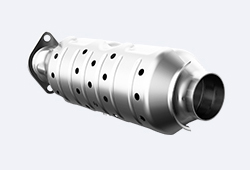
Exhaust Gas Reduction Technology for Gasoline Engines
As diesel vehicles have garnered their popularity thanks to their higher fuel efficiency, GDI (gasoline direct injection) engines have also drawn much attention. The GDI engine that directly injects gasoline into the cylinders is different from previous existing engines, as it requires a countermeasure for the particle number (PN). SJG SEJUNG is in the process of developing the GPF (gasoline particulate filter), which reduces particulate matter emissions from GDI engines, in response to internationally strict emissions regulations. We are focusing on developing a technology to minimize noise, vibration and harshness (NVH).
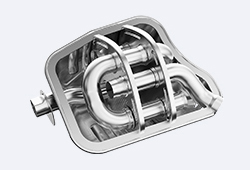
Technology for Noise Reduction with the Semi Active Muffler (SAM) and Improved Engine Performance
The Semi Active Muffler (SAM) employs variable valves that reduce exhaust noise by adeptly regulating the hydraulic pressure of flowing liquid and gas on the inside and at the outlets of tubes, which have a frequently changing flow rate. The noise reduction effect is excellent at a low load (i.e. low RPM). We are currently focusing on research and development of products with improved fuel efficiency and driving performance by reducing weight.
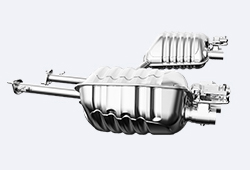
Electric Control Exhaust Valve (ECEV) Technology for Reduced Back Pressure, Emissions and Noise Pollution
The Electric Control Exhaust Valve dexterously regulates exhaust system pressures (differential pressure with air pressure, backpressure) with a variable flow rate depending on vehicle’s operating condition. SJG SEJUNG is in the process of developing an electric valve that covers the disadvantages of existing variable valves that rely on the flow rate of exhaust gas. We are dedicated to develop a highly effective electric valve with improved driving performance and fuel efficiency, and reduced backpressure and noise.
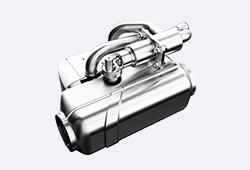
Exhaust Heat Recovery System Technology to Improve Fuel Efficiency
This technology has been developed in response to the tightened fuel efficiency regulations. It recovers discarded exhaust heat to reduce the amount of time to warm up the vehicle engine, thereby improving a power train cooling efficiency. It rapidly warms up an engine, which prevents energy waste and lowers viscosity of the transmission fluid. We envision that it will improve fuel efficiency and heating performance during the cold season.
MANUFACTURING TECHNIQUE
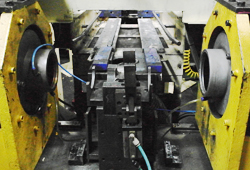
Automatic Specifications Inspection System
It is a screening device that automatically sorts defective products by scanning and comparing them with an established standard in advance.
If a product is determined to be defective, the next process is automatically halted so that it prevents producing defects in the final manufacturing stage. Moreover, it helps check defects of various parts including welding so that it increases reliability and accuracy of products.
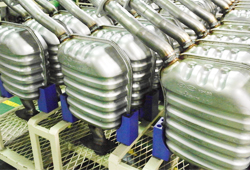
Engine Torque Improvement Muffler at Low and Middle Speeds
Engine Torque Improvement Muffler at low and middle speeds helps improve efficiency of the vehicle by improving fuel efficiency and power. It contributes to increasing fuel economy and power as it improves torque at low and medium engine speeds.
Generally, in case of four-cylinder engines, the gases hardly result in a vortex, but in case of sixcylinder engines, a room that the gases occupy is not enough, which results in a vortex. Since it may cause power loss and adversely affect the efficiency of the vehicle. A low-medium speed torque muffler is employed to prevent the adverse situation.
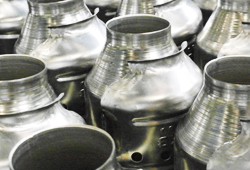
Spinning method
A purpose of the spinning method is to reduce the number of processes and the amount of materials required for producing parts. It completes molding of the pipe in the process of ramming the pipe by rotating a roller at high speed. Since a can pipe with built-in catalysts is usually processed for harmonization with other parts, thanks to the spinning process, molded products become more precise.
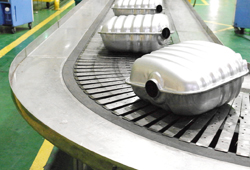
Hydro-Forming Method
During the production of a complex shaped automotive part, this technology is not to produce each part with various formed presses and welds, but to manufacture final products at once after tube-shaped steel plate is made and strong water pressure is applied into the tube.
SJG SEJUNG is manufacturing lighter and more durable parts than existing ones as well as manufacturing complex products using the hydro-forming method. It is also cost-effective as it significantly reduces the number of processes.
CONSTRUCTION TECHNIQUE
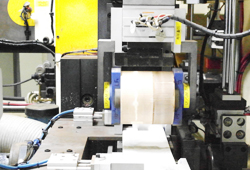
Size-to-fit
Size-to-fit is a technology used in the “warm-up” catalytic converter and the “under-floor” catalytic converter production, which reduces error rates and increases accuracy during the process when a catalyst is connected to a pipe. To produce the “under-floor” catalytic converter and “warm-up” catalytic converter, a slight error in size between the catalyst and the pipe may occur while inserting a catalyst in the pipe. Thus, in this process, a larger pipe than the catalyst is fabricated. Then, the external diameter of the pipe is calculated. Eventually, their sizes are perfectly fit to each other.
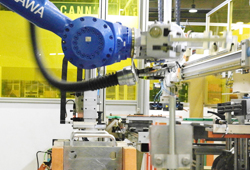
DDM(Deep Drawing Method)
DDM is the abbreviation for the deep drawing method and was developed to bypass a patent of the eccentric spinning as well as replace the spinning method, which needs expensive initial investment. We, SJG SEJUNG are able to achieve improvement of productivity, stable quality management, and cost savings with a self-developed technology that consists of placing a large plate on a press to be shaped into a pipe, which is different from existing pipe molding methods.
WELDING TECHNIQUE
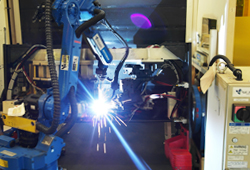
Oscillator method
Oscillator method extends the range in which will weld parts by shaking the welds using a vibration during welding so that even a single error is able to be included in the welding targets.